Agent, automation or assistant?
When I compare tools for robin.vision, the word "agent" turns up in a great many product descriptions. It can mean very different things – and that difference is exactly what matters when you choose.
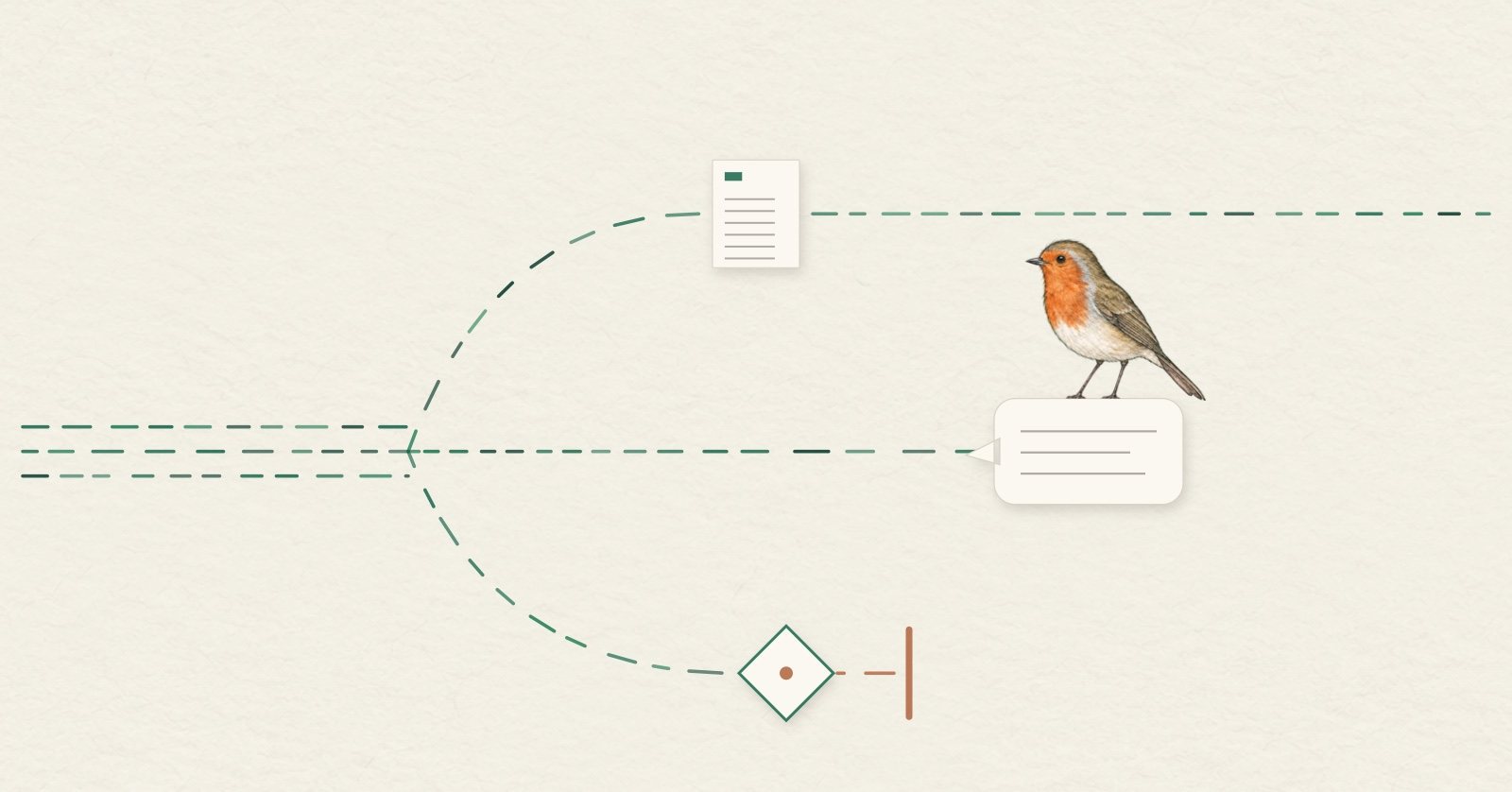
Three kinds of software tend to get lumped together at the moment. Automation follows fixed rules: same input, same result. It is fast and can be checked, but it only knows what someone has set up in advance. An assistant answers questions and makes suggestions; a person decides and acts. An agent, by contrast, pursues a goal, decides on the next step itself and carries it out – even where no rule has been laid down.
Gartner calls the confusion "agent washing": existing products such as AI assistants, robotic process automation or chatbots are rebranded as agents without any substantial agentic capabilities. Gartner estimates that only about 130 of the thousands of agentic AI vendors are the real thing (press release, 25 June 2025). Many use cases sold as agentic today, it says, do not need an agent at all. Its advice is down to earth: agents where decisions are needed, automation for routine work, assistants for simple look-ups.
A made-up example: a vendor advertises an AI agent for incoming invoices. In testing, the software assigns every invoice to an account based on the sender – a fixed rule of the kind many accounting packages already offer. Useful, but not an agent. An invoice that matches no purchase order is a different matter: it calls for a decision. An agent could prepare that decision, draft the query to the supplier and put the case on hold until a person has decided.
That gives you one simple question for every vendor: what does your agent decide on its own, and where does it stop? If the answer is "nothing", you are looking at automation – often the better choice, because it can be checked. As I wrote in "Mistakes multiply", rules repeat their mistakes; an agent can make new ones as well. Either way, someone needs to keep an eye on it.
Where in your practice would an agent genuinely make a decision – and where would a good rule do?